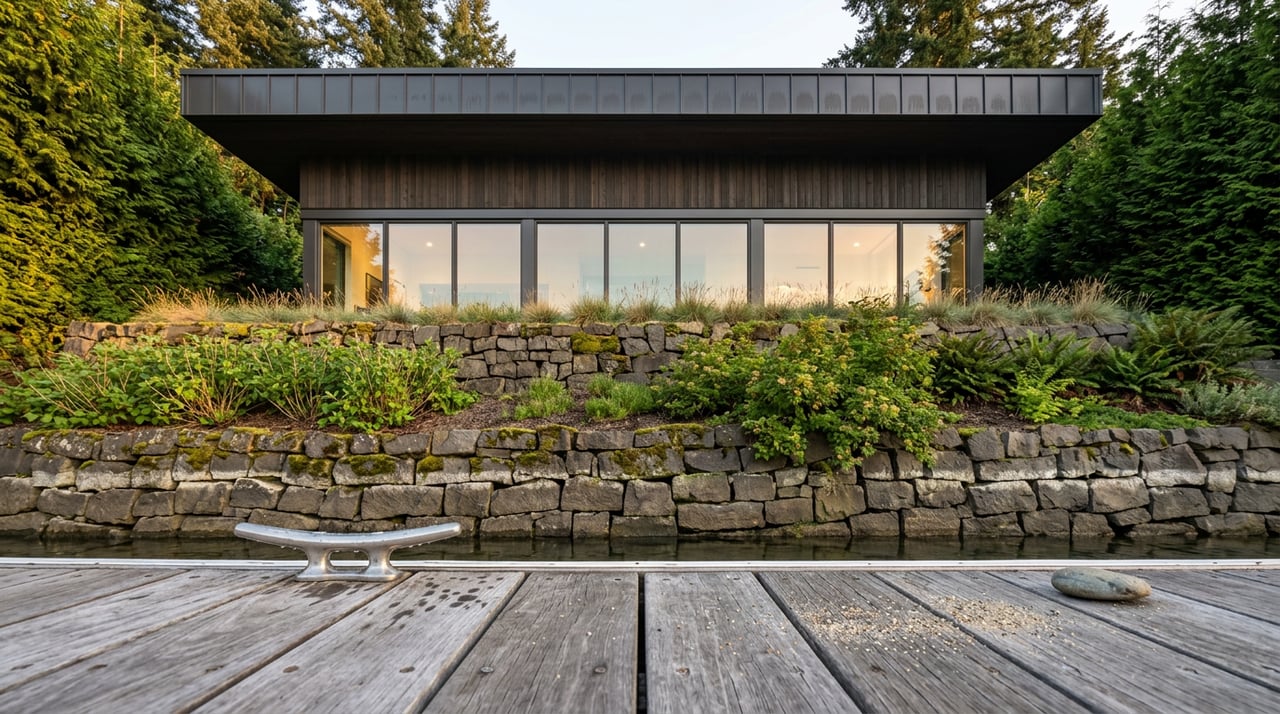
A buyer walks the dock at a lakefront listing in Harrison, pictures summer mornings with coffee and a kayak, and assumes the wooden structure jutting into Lake Coeur d'Alene comes with the sale the same way the kitchen appliances do. It usually does not work that way. In Harrison, that authority splits down an invisible line, and the two sides do not run on the same paperwork.
This matters more than it would in most North Idaho lake towns because of where Harrison sits. The city occupies the southeastern shore of Lake Coeur d'Alene, close to where the St. Joe River and the Coeur d'Alene River both feed in. Some of that water and lakebed falls inside the boundary of the Coeur d'Alene Reservation. Some of it does not. A dock built on one side answers to the Idaho Department of Lands under state law. A dock built on the other answers to the Coeur d'Alene Tribe's Shoreline Protection Program under tribal law. Harrison's own city code spells this out directly, stating that tribal submerged lands and waters within the reservation boundary remain under the tribe's jurisdictional control and are not subject to city ordinances at all.
A town built at the wrong angle for simple rules
Harrison's geography is not an accident of modern zoning. In the early 1900s the town was a shipping port for lumber, sitting at what was then considered a prime junction of the St. Joe and Coeur d'Alene Rivers. Before a fire in 1917, Harrison was on track to become the county seat of Kootenai County. After the fire, the mills relocated to the city of Coeur d'Alene, and the county seat went with them. Harrison stayed put, right at the confluence that later became a jurisdictional seam once the Coeur d'Alene Reservation boundary and the modern regulatory map were drawn around it.
That seam is why a home search here needs one more question than a search in Post Falls or Hayden Lake: not just "does this property have a permitted dock," but "which government issued that permit, and does it survive a change of ownership."
Two governments, two sets of paperwork
The differences are not cosmetic. They affect what a buyer needs to verify before closing and what a seller needs to have on hand before listing.
| State of Idaho (Idaho Department of Lands) | Coeur d'Alene Tribe | |
|---|---|---|
| Governing authority | Idaho Lake Protection Act, Idaho Code Title 58, Chapter 13 | Coeur d'Alene Tribal Law and Order Code and the Tribe's Encroachment Standards, adopted in 2005 |
| What triggers a permit | Any dock on a navigable lake | Any structure on, in, or above submerged lands or waters within the Reservation boundary |
| Transfer on sale | Request for Assignment form plus a $300 fee, submitted to the appropriate Supervisory Area Office | Encroachment Dock Lease Transfer Application, due within 30 days of the property changing hands |
| Federal overlay | Often paired with a U.S. Army Corps of Engineers review under the Regional General Permit for Idaho |
Neither system assumes the other exists. A title report will show who owns the upland parcel. It will not tell a buyer whether the dock in front of that parcel has a valid, transferable state encroachment permit or a valid, transferable tribal one, and it will not tell a seller whether the permit they inherited years ago was ever formally reassigned to them in the first place. The Coeur d'Alene Tribe's own numbers give a sense of how much of this activity is happening quietly in the background. As of 2022, tribal staff had processed permits for more than 250 existing dock upgrades and over 50 new docks on Tribal Waters since the 2005 standards were adopted, a volume that suggests plenty of transactions where this paperwork mattered and plenty where it may have been missed.
What changed this summer
The state side of this picture just moved. IDAPA 20.03.04, the rule set governing beds, waters, and airspace over Idaho's navigable lakes, was revised by the 2026 Idaho Legislature and took effect on July 1, 2026. Anyone closing on Harrison waterfront right now, or listing it for the first time this fall, is operating under rules that are a little over two months old. That is not a detail to skip past. Encroachment permit conditions, application review, and the standards a dock has to meet can all shift when a rule set is rewritten, and a permit that was compliant under the old version deserves a second look under the new one before anyone assumes it still fits.
The lake does not hold still either
Permitting jurisdiction is only half of the timing problem. Lake Coeur d'Alene is not a static body of water. Its summer elevation is held near 2,128 feet by a dam on the Spokane River in Post Falls, but before that control kicks in each year, the lake can run more than seven feet higher during spring runoff. Drawdown for the fall begins after Labor Day. That swing is not just a boating inconvenience. It governs when permitted construction work can legally happen at all. The Army Corps of Engineers' general permit for Idaho requires that excavation and backfilling of dock footings be done in the dry, during low water conditions. Piers and floating docks are limited to a deck area of 700 square feet for single use, and they cannot extend past the line of navigation, generally capped at 55 feet.
Put plainly: if a buyer wants to repair or replace a dock after closing, that work has a seasonal window, and the window is dictated by a dam operator's schedule, not the buyer's moving timeline. A closing in June, when the lake is still rising toward summer pool, is not the moment to plan dock construction. Late summer through fall drawdown is.
What to check before you write an offer
For anyone getting serious about a specific Harrison property, a short list of questions does most of the protective work.
- Ask the seller for the dock's encroachment number and confirm whether it was issued by the Idaho Department of Lands or the Coeur d'Alene Tribe. The Tribe's own encroachment map lets an owner search by that number.
- Confirm the permit was formally reassigned at the last sale.
- If the parcel has more than 250 feet of shoreline frontage, ask whether Kootenai County's Shoreline Management Area rules allow a second stairway, walkway, or tram, since the county caps this at one per parcel unless that frontage threshold is met.
- If any shoreline work, grading, or vegetation removal happened recently, ask whether it stayed outside the county's 25-foot No Disturbance Zone, which restricts mechanical ground disturbance and chemical use close to the water's edge.
- If dock repair or replacement is part of the plan, ask a marine contractor familiar with the lake, such as HDB Marine, which has built docks on Lake Coeur d'Alene for more than four decades, about realistic timing given the current water level and drawdown schedule.
None of this changes what makes Harrison worth the drive. The town still has its sandy public beach, the Kootenai County-managed docks that offer free 48-hour moorage, the Trail of the Coeur d'Alenes running out toward Chatcolet Bridge and Heyburn State Park, and small businesses like the Harrison Trading Post and Harrison Idaho Water Adventures that keep the summer lake culture running. What changes is how a buyer or seller should treat the dock itself: not as an included fixture, but as a separate asset with its own government, its own paperwork, and its own calendar.
A few questions worth asking before you sign
Does every waterfront property in Harrison need a separate dock permit? Yes, in the sense that the dock itself is a regulated structure independent of the home.
What happens if a dock's permit was never formally transferred to the current owner? That gap can complicate a sale.
Can a new owner add a boat lift or expand an existing dock without new permitting? Generally no. Any change to size, configuration, or use typically requires its own review, whether that review comes from the Idaho Department of Lands, the Coeur d'Alene Tribe, or both, depending on where the structure sits.
If you are weighing a lakefront purchase or a sale in Harrison and want someone who already knows which questions to ask before the paperwork becomes a problem, Dream Homes Idaho can walk the shoreline with you and help you find your Idaho dream home with the permitting details sorted out ahead of time, not after closing.
This article is general information, not legal, tax or financial advice. Consult a qualified professional about your situation.